
A gold standard climate engineering partnership for the Winter Olympics

A historic tradition
The Olympic Games are a global event and part of a long-standing tradition celebrating the competition and resilience of the world’s greatest athletes. The 2026 Winter Olympic Games continue this honoured legacy, and Systemair Italy is proud to collaborate with distinguished partners in supporting the development of the Milano Santa Giulia Arena, the main venue for the ice hockey tournaments at Milano Cortina 2026.
The main client for this project is Arena Impianti Scarl, a company established specifically for this large-scale development. It brings together three installation companies, Sinelec from Turin, Gianni Benvenuto from Cernobbio (Como), and Elettromeccanica Galli from Erba (Lecco), all of which are long-standing Systemair customers in their daily operations. Studio Arup (Milano) and Studio Prodim (Torino) served as consultants, while the contractor was Itinera Spa. The developer of the MSG Arena Milano is the CTS Eventim Group. Together, these partners are all esteemed organisations widely recognised for delivering major, large-scale projects.
Pillars of the arena
The Arena was built on three pillars: Multifunctionality, Sustainability (LEED), and Spectator Experience, and these translated into three essential technical requirements shaping the project from the beginning.
First, thermo-hygrometric control was critical. The arena must switch between Ice Mode for hockey and Concert Mode within hours, requiring massive dehumidification capacity to prevent fog over the ice while maintaining comfort for up to 16,000 spectators.

Second, acoustic excellence played a defining role. Located in an urban district, both noise “break-out”, meaning sound escaping the building, and “break-in”, meaning HVAC noise disturbing performances, had to be strictly controlled. All ventilation units, therefore, needed to operate with extreme acoustic precision and silence.
Third, the arena targets LEED Gold certification, meaning every component, including air handling units and fans, must contribute to strict energy-efficiency targets and reduced CO₂ emissions
A non-negotiable deadline
The strict requirement to guarantee specific technical performance scores in order to achieve the LEED certification level requested by the developer represented a significant challenge. However, another defining issue was the timeline, arguably the most critical constraint of the project. The 2026 Winter Olympics created a non-negotiable deadline, and everything had to be ready before the Games began.
The project began in 2020, followed by groundbreaking in the second quarter of 2023. Trevi completed piling and foundations in just three months, after which structural works throughout 2023 and 2024 saw the rise of the three metallic rings and elliptical shell. Between 2024 and 2025, Arena Impianti Scarl installed the MEP heart of the building, and in the final quarter of 2025 the arena entered testing and commissioning, including final air balancing and ice management trials. On 6 February 2026, the venue was set to host its first official Winter Games matches.
Integrated system supply
Systemair provided equipment and systems representing a multi-million-euro investment, effectively delivering an almost complete HVAC solution for the arena. The scope included air curtains and controls, circular and rectangular duct fans, EC thermo multibox units, roof fans, smoke extract fans, axial fans, silencers, plastic exhaust fans, fire dampers, smoke dampers, VAV units, dampers, diffusers, grilles, louvres, and valves.
The supply covered heating products such as AR, ARFEC and PAFEC; fans and accessories including MUB, MUB/F, MUB/T, MRH, AXC and AXC/F; fire safety solutions including FDS, FDR, S-SA1 and S-SA2; and air distribution products including VVKR-S, DF-48, LK-70 and NOVA.
Beyond the scale of supply, the project relied heavily on technical collaboration from the earliest design stages. The design studio chose to work with Systemair from the outset due to our technical expertise and the support provided by our team. All Systemair products include performance data tested in laboratories, ensuring full certainty in technical data and dimensions. The availability of nearly all products in BIM format offered a significant advantage over competitors, while our deep understanding of LEED certification requirements provided additional assurance as the project progressed into installation.

Equipment and engineering support
Beyond the scale of supply, the project relied heavily on technical collaboration from the earliest design stages. The design studio chose to work with Systemair from the outset due to our technical expertise and the support provided by our team. All Systemair products include performance data tested in laboratories, ensuring full certainty in technical data and dimensions. The availability of nearly all products in BIM format offered a significant advantage over competitors, while our deep understanding of LEED certification requirements provided additional assurance as the project progressed into installation.

Systemair Days – Karachi 2026, organised in partnership with Welkin Solutions, concludes with strong industry participation
Systemair, a leading global Swedish ventilation provider, and Welkin Solutions, a leading distributor of HVAC and cleanroom solutions in Pakistan, successfully concluded “Systemair Days – Karachi ,” industry event on 21 January 2026 at the Marriott Hotel in Karachi, Pakistan.
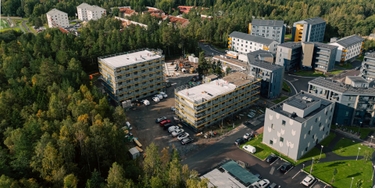
The ventilation system is integrated already at the housing factory
When student housing is built as modular units for Karlstad University, the ventilation system is installed in each apartment module already at the factory. This provides better control over the final result while also giving installers a safer working environment.

Robert Larsson is leading the Systemair Group
At the very beginning of 2026, Robert Larsson assumed the position of President and CEO of Systemair.