
The Fan System Is Integrated Already in the Housing Factory
In an increasingly sound dampened world, the issue of noise has become highly relevant. In recent years, noise reduction requirements have tightened, and as we grow accustomed to quieter technology in our homes, expectations for an improved acoustic environment continue to rise. A building’s ventilation system is no exception. Fresh air should ideally be delivered silently, even though the system is powered by large, high capacity fans.
Mikael Lönnberg, R&D Manager at Systemair in Skinnskatteberg, Sweden, works together with his team to find the optimal solutions.
“We measure the noise levels of every product we manufacture. These measurements are important when customers plan their installations, where several products may need to work together. It’s the combined noise that reaches the room through the duct system that must be managed. Without the right input data, the wrong type of sound attenuation might be installed, which can be both expensive and difficult to fix afterwards,” Mikael says.

Systemair is connected to, and accredited by, the certification system governed by the global industry organization AMCA. All equipment is measured according to the same standard so that noise levels can be stated in the product information. Systemair optimizes and tests all products to make them as quiet as technically possible. The tests are carried out in a sound room where the acoustic environment is controlled so that the measurement can define the product’s sound power. As early as 1996, Systemair in Skinnskatteberg became Europe’s first AMCA certified lab for testing airflow and sound. Since then, the company has established certified laboratories in Germany, India, and the USA.
Requirements for low noise levels have existed for a long time, but they have tightened in recent years. The Nordic region has been a pioneer in this area. In a residential home, 35 dB is acceptable, but there are stricter requirements for spaces such as bedrooms. “If you have a poor acoustic environment, it becomes difficult to concentrate,” says Mikael Lönnberg.

Häggmarks is building just over 200 student apartments for Karlstad University, where each unit will have its own heat recovery ventilation system (FTX) to ensure the best possible air quality. The apartments are small, and the sleeping alcove is close to where the the ventilation unit is placed, which makes low noise levels especially important.
In these modular units, the ventilation system is installed in each apartment already at Häggmarks’ factory — a working method that is both efficient and ensures control over the final result, while also improving safety for the installers. Integrating the ventilation system during the module construction is a clear example of how quality and living comfort are improved for the students, while the installation process becomes smoother.
What is FTX?
Within HVAC FTX stands for:
F = From air (outgoing)
T = To air (incoming)
X = Heat exchange
With a ventilation unit with heat exchanger (FTX unit), the heat from the outgoing air can be recovered to heat the incoming air, which saves energy.
Read more about SAVE residential air handling units

Systemair SAVE VTR 150/k mounted in a modular unit.
Read more about:

Robert Larsson is leading the Systemair Group
At the very beginning of 2026, Robert Larsson assumed the position of President and CEO of Systemair.
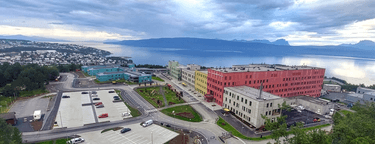
Systemair ventilation system for new hospital complex in Narvik, Norway
The new Narvik department of the University Hospital of North Norway was completed in 2024. Adjacent to the hospital are an ambulance station and a health care centre.

Stockholm Metro – ventilation for a demanding environment
Systemair delivers ventilation solutions for the extension of the Blue Line of the Stockholm metro, Sweden.